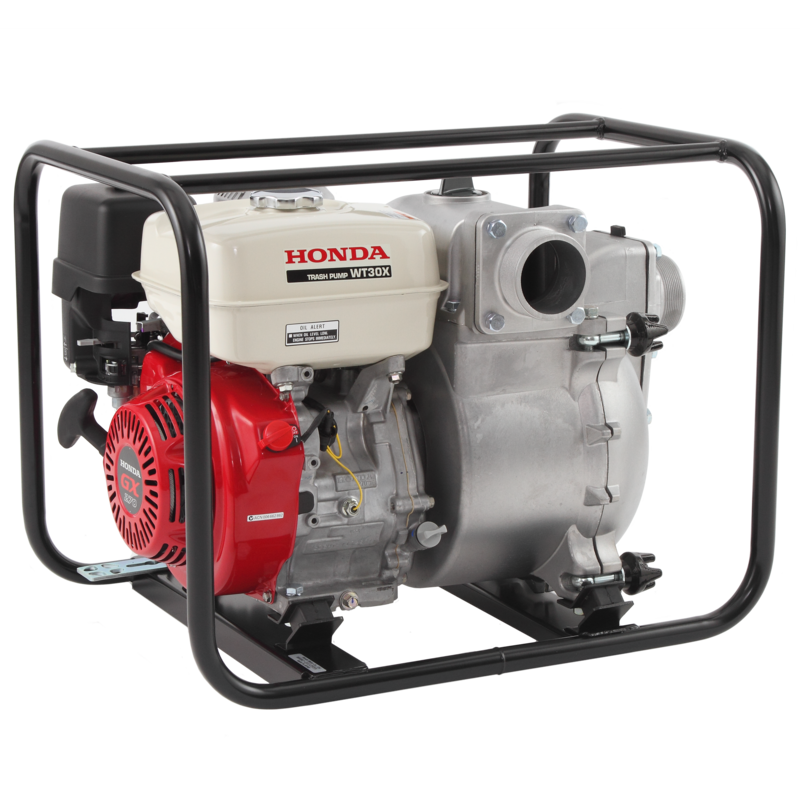

Honda WT30 3-Inch Trash Pump
WT30
-
 Free Delivery in 3-5 Working Days
 -
 Flexible Rental Period
 -
 Free Easy Returns
Product Overview
The Honda WT30 is a 3-inch centrifugal trash pump for water mixed with debris, delivering up to 1,210 litres per minute from a Honda GX270 engine.
Product overview
The WT30 is designed for demanding water-transfer work where debris may be present, including construction sites, mining sites and storm drains. Its self-priming centrifugal trash-pump design is supported by a roll frame and Honda GX270 four-stroke engine.
Supported specifications
Model: WT30
Pump type: Centrifugal trash pump
Suction and discharge port diameter: 80 mm (3 inches)
Maximum total head: 27 m
Maximum suction head: 8 m
Maximum capacity: 1,210 L/min
Maximum solids: 17 mm
Engine: Honda GX270
Displacement: 242 cc
Fuel: Unleaded 91
Fuel tank capacity: 5.3 L
Dry weight: 61 kg
Dimensions: 660 × 495 × 515 mm
What's in the box
-
Model
WT30
-
Pump Type
Centrifugal trash pump
-
Port Diameter
80 mm (3 inches)
-
Maximum Total Head
27 m
-
Maximum Suction Head
8 m
-
Maximum Capacity
1,210 L/min
-
Maximum Solids
17 mm
-
Engine
Honda GX270
-
Displacement
242 cc
-
Fuel
Unleaded 91
-
Fuel Tank Capacity
5.3 L
-
Dry Weight
61 kg
-
Dimensions
660 × 495 × 515 mm
-
Self Priming
Yes
-
Mounting
Roll frame
Expert Local Advice
Friendly, experienced & local
Leading Brands
Quality Brands you can trust
Service & Spare Parts
Workshop Parts & Support
Residential & Commercial
Equipment for every job
FAQ
What type of water pump do I need?
The right pump depends on what you need to move, how much water you need to move and how far or high it must travel. A volume or transfer pump is designed to move large quantities of relatively clean water, while a high-pressure pump is better when water must be delivered over greater distances, to higher elevations or through equipment requiring pressure. Trash pumps are designed for dirty water containing suspended solids and debris.
What is the difference between a transfer pump, high-pressure pump and trash pump?
Transfer pumps are primarily designed to move large volumes of clean or relatively clean water efficiently. High-pressure pumps sacrifice some maximum flow in order to generate greater pressure and head, making them useful for applications such as irrigation, long-distance transfer, wash-down and firefighting. Trash pumps use a pump design that allows larger suspended solids and debris to pass through without easily clogging the pump.
How much water flow do I need from a pump?
Flow rate is normally shown in litres per minute and tells you how quickly a pump can move water under particular conditions. Higher flow is useful when filling tanks, draining large areas or moving substantial volumes of water quickly. The important figure is not simply the pump's maximum advertised flow, however, because actual flow decreases as the pump has to lift water higher, push it further or overcome friction in hoses and fittings.
What does total head mean when choosing a water pump?
Total head describes the overall resistance the pump must overcome to move water through your system. It includes the vertical distance the water must be lifted as well as losses caused by the suction line, delivery hose, pipe length, bends, valves and other fittings. This is why a pump that delivers a very high flow at low head may deliver substantially less water when pumping uphill or over a long distance.
How high can a pump lift water from a dam, creek or tank?
The vertical distance between the water surface and the pump is known as suction lift. Portable self-priming centrifugal pumps commonly have a maximum suction lift of around 7 to 8 metres under favourable conditions, but practical performance reduces as suction height increases. For best performance, position the pump as close to the water source and as low as is safely practical, keep the suction hose short and make sure all suction connections are airtight.
What size pump and hose should I use?
Pump sizes such as 1 inch, 2 inch or 3 inch generally refer to the inlet and outlet diameter. Larger hoses can carry substantially more water and reduce friction losses, which can make a major difference over longer distances. A smaller pump is often suitable for portable or lower-flow jobs, while 2-inch and 3-inch pumps are common where larger volumes must be transferred. The best size depends on the required flow, distance, elevation and hose length.
Can I pump dirty water, muddy water or water containing debris?
Only if the pump is designed for it. Standard volume and high-pressure pumps are generally intended for clean or relatively clean water and can be damaged or clogged by excessive sand, stones or debris. Trash pumps are specifically designed to pass suspended solids and are a better choice for construction sites, muddy water and similar applications. Always check the manufacturer's maximum solids specification and use an appropriate suction strainer.
What pump should I use to transfer water from a dam to a storage tank?
Choose the pump according to the vertical rise from the dam to the tank, the horizontal distance, the hose or pipe diameter and how quickly you want the tank filled. A volume pump may be suitable where the distance and elevation are modest, while a high-head or high-pressure pump may be required for a long delivery line or a tank located well above the water source. Larger delivery pipe can also significantly reduce friction loss and improve the amount of water reaching the tank.
Does a self-priming pump still need to be primed before use?
Usually yes. Self-priming means the pump can remove air from the suction line and draw water up once the pump casing has been filled correctly. It does not normally mean the pump should be started completely dry. Before starting, fill the pump casing as specified by the manufacturer, make sure the suction hose and fittings are airtight and ensure the suction strainer is submerged in the water.
Can I use a water pump for firefighting?
For property fire protection, use a pump specifically designed to provide the pressure, flow and reliability required for firefighting rather than assuming that any transfer pump will be suitable. High-pressure fire pumps are designed to maintain useful pressure through firefighting hose and nozzles and may provide multiple outlets. Pump performance, available water supply, hose length, suction conditions and the overall fire-protection setup should all be considered before choosing a system.
Expert Local Advice
Friendly, experienced & local
Leading Brands
Quality Brands you can trust
Service & Spare Parts
Workshop Parts & Support
Residential & Commercial
Equipment for every job